
Some people say they are tired when they need a weekend off. Others say they are tired when life has simply been busy.
Then there is the kind of fatigue that changes a life.
This is often what people with ME/CFS experience. Chronic Fatigue Syndrome, also called Myalgic Encephalomyelitis, is not ordinary tiredness. It is a deep exhaustion that sleep does not fix, motivation cannot overcome, and willpower cannot solve.
Many patients say they feel as if their body battery never recharges. They may sleep all night and wake feeling worse than when they went to bed. A short walk, emotional stress, poor sleep, grocery shopping, or even a social visit may trigger a crash that lasts days.
For many, the hardest part is not only the illness itself. It is how invisible it can be.
People may hear, “Your bloodwork is normal.”
“You just need exercise.”
“Maybe it is stress.”
“You look fine.”
But looking fine and feeling fine are very different things.
ME/CFS often affects far more than energy.
People may experience brain fog, poor memory, headaches, dizziness, sore throat, swollen glands, body pain, digestive issues, sleep disturbance, anxiety, sensitivity to noise or light, racing heart, and flu-like feelings without infection.
Some feel as though they are permanently recovering from a virus that never fully left.
Modern research increasingly supports that this is a real multisystem illness involving the nervous system, immune system, energy metabolism, sleep regulation, and stress response.
It is not laziness.
It is not weakness.
It is not a character flaw.
One of the most frustrating experiences for patients is being told to push through.
Exercise is healthy for many people, but in ME/CFS, overexertion often backfires. A person may do a workout, clean the house, or push through a demanding day, only to collapse afterward.
This delayed worsening is called post-exertional malaise, and it is one of the most important features of the illness.
The body is not refusing effort. It is failing to recover from effort.
That changes everything.
Chinese medicine has long recognized fatigue conditions that appear after illness, overwork, stress, emotional strain, or long-term depletion.
The classical material you shared describes chronic fatigue as a condition involving several systems at once, especially a disharmony between the Liver and Spleen.
In modern language, this often looks like a person who is exhausted, bloated, mentally foggy, emotionally reactive, and unable to bounce back.
The digestive system is weak. Stress tolerance is poor. Sleep is not restorative. Energy feels stuck and depleted at the same time.
Many patients instantly recognize themselves in that description.
In Chinese medicine, digestion is central to energy production.
When digestion is impaired, the body may not transform food efficiently into usable energy. Patients often notice bloating after meals, loose stools, low appetite, sugar crashes, heaviness, and fatigue that worsens after eating.
They may think they need stimulants, when what they really need is better energy production.
This is one reason treatment often includes the gut, not only fatigue itself.
Many people with chronic fatigue notice they are “fine until stress happens.”
Then symptoms flare.
Chinese medicine often explains this through Liver constraint. When stress is bottled up, sleep worsens, digestion tightens, hormones fluctuate, muscles tense, and the nervous system becomes less resilient.
The result is that even minor stress can feel physically overwhelming.
Chinese herbal medicine can be valuable because it does not simply try to stimulate the body like caffeine.
Many fatigued people are already overstimulated internally. They feel tired but wired, exhausted but unable to sleep, depleted but anxious.
Good herbal treatment aims to help the body regulate energy, improve recovery, calm the nervous system, and strengthen the systems that create resilience.
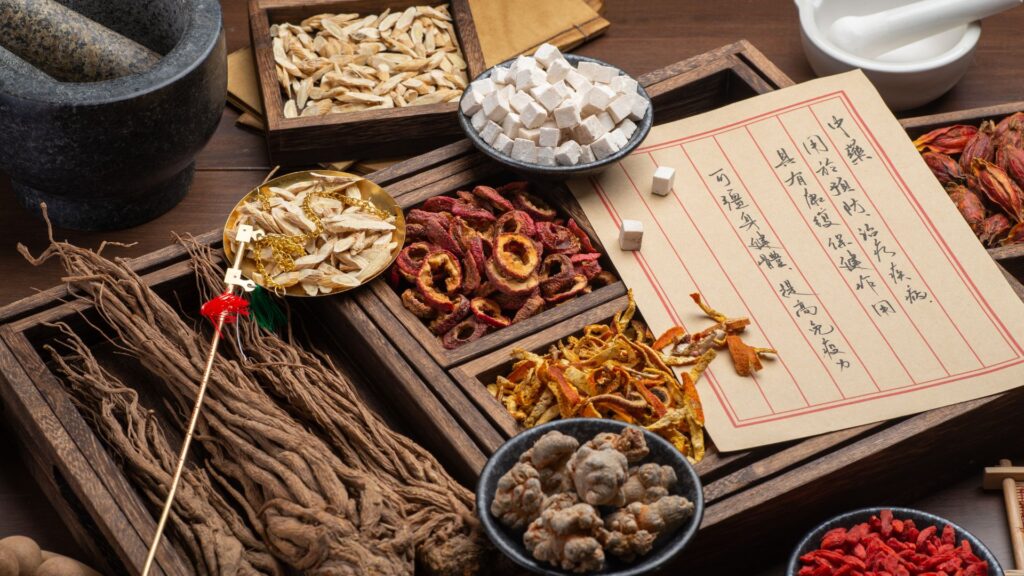
The text you shared discusses Huang Qi, one of the most respected herbs for fatigue, poor immunity, spontaneous sweating, and slow recovery.
It also includes Dang Shen, often used when energy is low, thinking feels dull, appetite is weak, and the body feels drained.
Bai Zhu is commonly used when fatigue comes with bloating, heaviness, or dampness.
Dang Gui may be chosen when fatigue is mixed with poor circulation, dizziness, dryness, or menstrual depletion.
He Shou Wu has traditionally been used in long-term weakness and recovery states.
When patients feel hot at night, sweat easily, or feel wired and restless, herbs such as Wu Wei Zi or Huang Bai may be considered.
This is where individualized treatment matters. Two tired people may need completely different formulas.
Interested in Chinese herbal medicine as part of your recovery?
Learn more about how personalized herbal formulas are prescribed and dispensed at Victoria Healing Space.
Many people think acupuncture is only for pain. In reality, it can be deeply supportive for people whose nervous systems feel overwhelmed.
When used carefully, acupuncture may help regulate stress physiology, improve sleep, support digestion, reduce pain, calm anxiety, and gently improve resilience.
The classical text highlights Zu San Li (ST36), a famous point often used for energy, digestion, and recovery, along with San Yin Jiao (SP6) and Tai Chong (LV3) for regulation and stress-related patterns.
For some patients, the first sign of healing is not suddenly having energy. It is sleeping better, feeling calmer, digesting better, and crashing less often.
Those are meaningful victories.
Many patients have been taught that discipline solves everything.
Sometimes discipline helps. Sometimes it harms.
With ME/CFS, pushing through severe fatigue often increases the crash cycle.
The older Chinese text you shared says exercise must be carefully adjusted so the result is more energy rather than further exhaustion.
That advice remains wise today.
Healing often begins when patients stop fighting their body and start listening to it.
ME/CFS can feel lonely, confusing, and life-altering. But many people improve when treatment respects the whole picture: energy production, sleep, digestion, nervous system regulation, pacing, stress recovery, and immune resilience.
Chinese medicine does not offer magic promises. It offers something often missing in conventional care: a personalized strategy.
Sometimes that is exactly where hope begins.
Centers for Disease Control and Prevention (CDC). ME/CFS clinical guidance.
National Institute for Health and Care Excellence (NICE). Myalgic encephalomyelitis/chronic fatigue syndrome guideline.
NIH / PubMed reviews on ME/CFS pathophysiology.
Research reviews on Astragalus, Schisandra, and traditional herbal medicine for fatigue syndromes.
Traditional Chinese medicine clinical reference text supplied by user.