
Fibromyalgia is one of the most misunderstood chronic pain conditions. Many patients live for years with widespread muscle pain, stiffness, exhaustion, poor sleep, brain fog, headaches, digestive symptoms, anxiety, and sensitivity to light, sound, smells, touch, or stress. They may look healthy from the outside, but inside they feel as if their body never fully rests.
One of the most painful parts of fibromyalgia is not only the physical pain. It is being dismissed.
Many people with fibromyalgia have heard some version of: “Your bloodwork is normal,” “Maybe it is stress,” “You just need to exercise,” or “It is all in your head.”
It is not all in your head.
Fibromyalgia is now recognized as a real chronic pain condition involving altered pain processing in the nervous system. Modern research often describes it as a form of nociplastic pain, meaning pain arises from changes in how the nervous system processes pain signals, even without clear tissue damage or visible inflammation. Patients may have severe pain, fatigue, and disability even when scans and standard labs do not show a structural explanation.
Fibromyalgia usually causes widespread pain affecting multiple areas of the body. The pain can feel deep, burning, aching, throbbing, stabbing, or heavy. Many patients describe waking up stiff, sore, and unrefreshed, as if they worked all night instead of sleeping.
Fatigue is often intense. Some people can still work and care for family, but they pay for it later with a flare. Others may struggle to get through basic daily tasks. Many describe their arms and legs as feeling heavy, weak, or weighed down.
Sleep is another major issue. A patient may fall asleep but not reach deep restorative sleep, or wake too early and feel exhausted. This matters because poor sleep increases pain sensitivity. Pain worsens sleep, and poor sleep worsens pain. The cycle can become very hard to break.
Brain fog is also common. Patients may forget words, lose focus, struggle with concentration, or feel mentally slow. This can be frightening, especially for people who are used to being capable and productive.
Fibromyalgia can also overlap with headaches, TMJ pain, irritable bowel syndrome, dizziness, cold hands and feet, restless legs, pelvic pain, interstitial cystitis, allergies, chemical sensitivity, painful menstruation, and mood changes. The clinical material I use describes fibromyalgia as a syndrome with many possible accompanying symptoms, including generalized pain, fatigue, stiffness, sleep disturbance, headaches, numbness and tingling, dizziness, sensitivity to light/noise/smell, IBS symptoms, palpitations, allergies, TMJ pain, restless legs, and bladder symptoms.
This is why fibromyalgia should never be treated as “just muscle pain.” It is a whole-system condition.
Chinese medicine looks at fibromyalgia through patterns rather than one single disease label. The traditional category often used is muscle impediment, but fibromyalgia also overlaps with patterns of fatigue, depression, insomnia, digestive weakness, dampness, blood deficiency, qi stagnation, blood stasis, and kidney deficiency.
The clinical material I use describes the core mechanism of fibromyalgia as liver-spleen disharmony. In patient language, this means stress and emotional tension disturb the smooth movement of qi, while digestion and energy production become weakened. Over time, this can affect muscles, sleep, mood, circulation, fluid metabolism, and pain sensitivity.
This is a very important idea.
Many fibromyalgia patients are not weak people. Often, they are people who have pushed too long. They have carried emotional stress, family responsibility, trauma, overwork, perfectionism, poor sleep, digestive issues, hormonal changes, or chronic inflammation for years. The body finally begins to speak through pain and exhaustion.
In Chinese medicine, the liver system relates to smooth flow, emotional regulation, muscle tension, and stress response. The spleen system relates to digestion, energy production, fluid metabolism, and nourishment of the muscles. When the liver and spleen fall out of balance, a person may feel tense, irritable, emotionally sensitive, bloated, fatigued, sore, heavy, and unable to recover.
This is why fibromyalgia often includes both pain and exhaustion.
One of the most useful clinical remarks in the Chinese medicine material is that primary attention should be given to insomnia. It states that much of the body pain may improve when sleep improves.
This makes sense from both Eastern and Western perspectives.
Modern pain science shows that poor sleep increases pain sensitivity and lowers the nervous system’s ability to regulate pain. In Chinese medicine, sleep is when blood, yin, and spirit are restored. If the body cannot enter restorative sleep, the muscles and nervous system never fully repair.
In clinic, I often see that fibromyalgia improvement begins quietly. The patient does not always wake up pain-free after one treatment. Instead, they may say, “I slept deeper,” “I woke less often,” “My body felt softer in the morning,” or “I recovered better after work.”
Those are important signs.
Many fibromyalgia patients also have digestive symptoms. IBS is very common. Some experience bloating, diarrhea, constipation, mucus in stool, food reactions, nausea, or heaviness after meals.
Damp-heat as a common complicating pattern in fibromyalgia. Damp-heat may appear in the digestive tract, urinary tract, reproductive system, skin, lower limbs, or sinuses, and it may move from system to system.
In plain language, this means some patients have a body environment where inflammation, heaviness, mucus, swelling, heat, irritation, and poor fluid metabolism keep recurring in different places.
This is why diet matters.
For some patients, symptoms worsen with sugar, alcohol, greasy foods, highly processed foods, excess dairy, or irregular eating. Others flare when they skip meals, eat too much raw cold food, or live on coffee and stress.
There is no universal fibromyalgia diet, but digestion must be respected. A body that cannot digest well cannot rebuild well.
Fibromyalgia pain often changes location. One day it is the neck and shoulders. Another day the hips and legs. Another day the jaw, ribs, or back.
In Chinese medicine, moving pain often suggests qi stagnation, wind, or dampness. Fixed stabbing pain suggests blood stasis. Heavy aching pain may suggest dampness. Burning pain may suggest heat. Pain with deep fatigue may suggest deficiency.
Blood stasis and phlegm often complicate chronic fibromyalgia patterns and should be addressed when present. Blood stasis may show as fixed sharp pain, pain worse at night, visible varicosities or spider veins, dark complexion, painful menstruation, clots, or a purple/dusky tongue.
This is why treatment changes from patient to patient and even from month to month.
Several systematic reviews and meta-analyses have found that acupuncture may help reduce pain, fatigue, and improve quality of life for some patients. A 2019 review of randomized controlled trials reported that acupuncture performed better than sham acupuncture for short-term pain relief. More recent reviews in 2024 and 2025 also found modest but meaningful improvements in pain, fatigue, anxiety, and overall symptom burden, while noting that more high-quality studies are still needed. This means acupuncture is not a miracle cure, but it is increasingly recognized as a reasonable supportive option for fibromyalgia.
From a modern medical perspective, fibromyalgia is linked to an over-sensitive nervous system, sometimes called central sensitization. In simple terms, the body’s alarm system stays switched on too long. Acupuncture may help by calming the nervous system, reducing pain signaling, relaxing chronic muscle tension, improving circulation, and supporting better sleep. Since poor sleep often worsens pain, even small improvements in rest can make a noticeable difference. Many patients describe feeling calmer, lighter, or less “wired” after treatment.
Clinically, acupuncture may help by calming the nervous system, reducing muscle guarding, improving circulation, modulating pain pathways, and supporting sleep. Many patients describe feeling as if their body finally “downshifts.”
That downshift matters. Fibromyalgia patients often live in a state of internal alarm.
Chinese herbal medicine is not one formula for fibromyalgia. It depends on pattern.
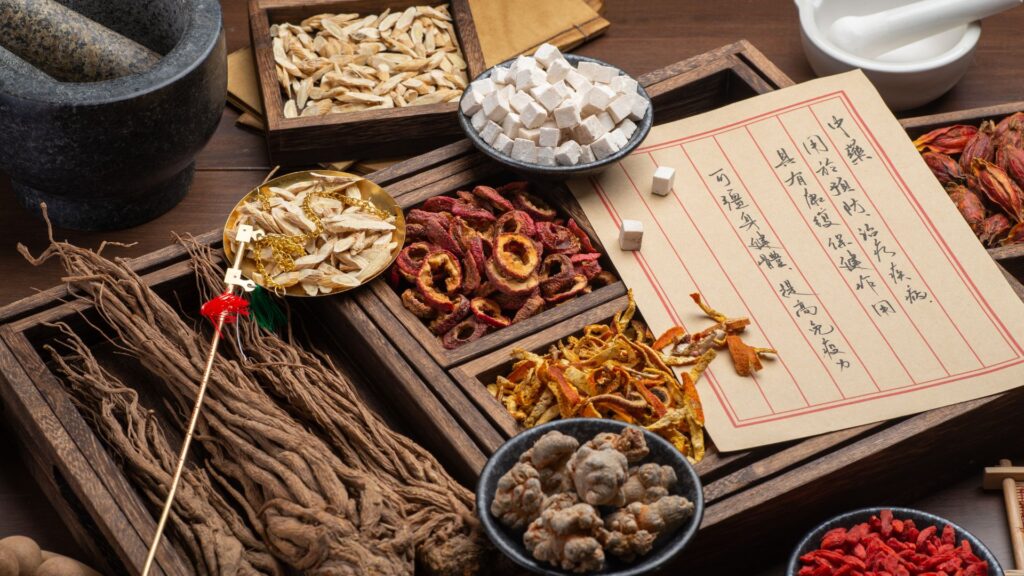
For liver-spleen disharmony, the source material discusses Xiao Yao San, with herbs such as Bai Shao, Chai Hu, Bai Zhu, Fu Ling, Dang Gui, Bo He, Gan Cao, and Sheng Jiang. The formula strategy is to course the liver, regulate qi, strengthen digestion, and support blood.
For more fatigue and weakness, herbs such as Huang Qi and Dang Shen may be added. For phlegm-dampness, herbs such as Ban Xia and Chen Pi may be used. For blood deficiency and muscle malnourishment, herbs such as Ji Xue Teng, Shu Di, Gou Qi Zi, and He Shou Wu may be considered. For insomnia, herbs such as Suan Zao Ren and Bai Zi Ren may be used.
For spleen-kidney yang deficiency, especially in perimenopausal women with coldness, fatigue, low back weakness, loose stools, low libido, frequent urination, and depression, the source discusses formulas that support spleen qi, kidney yang, and liver qi movement.
This is professional herbal medicine. It should be prescribed by a qualified practitioner, especially if the patient takes medications or has complex health conditions.
Fibromyalgia treatment should be gentle and layered. Aggressive treatment often backfires. Many patients are sensitive. Too much exercise, too much massage, too many supplements, or too strong a treatment can trigger a flare.
In some rare cases, acupuncture and massage may temporarily worsen symptoms when pain is due more to malnourishment than stagnation.
This is clinically important. Some bodies do not need to be pushed. They need to be reassured, nourished, and slowly retrained.
A good plan may begin with sleep, pain regulation, digestion, and nervous system calming. Later, the focus may shift to stamina, strength, mood, hormonal balance, and flare prevention.
Movement is still important, but it must be paced. For many patients, starting with gentle walking, stretching, breathwork, warm water movement, or very light strengthening is better than forcing intense workouts. The goal is not to prove discipline. The goal is to build capacity without crashing.
Historically, fibromyalgia was associated with tenderness in 18 specific paired points on the body identified by the American College of Rheumatology. These points were used as part of earlier diagnostic criteria and are still helpful for understanding common pain patterns seen in fibromyalgia. They include the base of the skull near the suboccipital muscles, the lower neck around the cervical spine, the midpoint of the trapezius muscles, the upper shoulder blade region near the supraspinatus muscles, the area of the second rib near the chest, the outer elbows just below the lateral epicondyle, the upper outer buttock region, the area behind the greater trochanter of the hips, and the inner side of the knees near the fat pad above the joint line.
Fibromyalgia is real. It is complex. It is not laziness, weakness, or imagination.
It is a condition where the nervous system, sleep, muscles, digestion, emotions, hormones, and stress response become deeply interconnected.
Western medicine helps explain fibromyalgia through pain processing, central sensitization, sleep disruption, and nervous system dysregulation. Chinese medicine adds a whole-person framework: liver-spleen disharmony, deficiency, dampness, heat, blood stasis, phlegm, insomnia, and emotional constraint.
For many patients, healing begins when they stop fighting their body and start understanding its signals.
The body is not betraying you. It is asking for a different kind of care.
Flaws, Bob; Sionneau, Philippe. The Treatment of Modern Western Diseases with Chinese Medicine. Blue Poppy Press.
EULAR revised recommendations for the management of fibromyalgia.
Jones EA, et al. Management of Fibromyalgia: An Update. 2024.
Bhargava J, Hurley JA. Fibromyalgia. StatPearls / NCBI Bookshelf.
Zhang XC, et al. Acupuncture therapy for fibromyalgia: a systematic review and meta-analysis. 2019.
Araya-Quintanilla F, et al. Effects of acupuncture versus placebo on fibromyalgia symptoms. 2024.