
Most men who experience erectile dysfunction don’t think of it as a long-term process.
It feels immediate. Something changes, and the focus quickly shifts to restoring function as soon as possible. In modern medicine, this often leads to fast-acting solutions designed to improve blood flow. These can be helpful, and in many cases they provide temporary relief.
But in clinical practice, erectile dysfunction rarely begins at the moment it becomes noticeable. It is usually the result of gradual changes within the body — changes in circulation, nervous system regulation, metabolic function, and emotional state that develop over time.
Erectile dysfunction is defined as the inability to achieve or maintain an erection sufficient for sexual activity, and it affects a significant portion of men, increasing with age . However, this definition does not capture what is most important: erectile dysfunction is often a reflection of how well the body is functioning as a whole.
An erection depends on a complex interaction between vascular, neurological, and hormonal systems. Blood vessels must dilate efficiently, nitric oxide signaling must be intact, nerve pathways must transmit signals without interruption, and the nervous system must be able to shift into a parasympathetic state.
When these processes are disrupted, the body cannot coordinate the response.
Research has shown that erectile dysfunction is strongly associated with endothelial dysfunction, a condition in which blood vessels lose their ability to expand properly. Because the arteries involved in erection are smaller than coronary arteries, they are often the first to show signs of vascular change. For this reason, erectile dysfunction is now widely recognized as an early indicator of cardiovascular disease and metabolic disorders .
This changes the clinical perspective. Erectile dysfunction is not only a symptom to treat — it is a signal to investigate.
Erectile dysfunction is rarely caused by a single factor. In most cases, it develops through a combination of physical and regulatory changes.
In some patients, the process is gradual and linked to vascular health, metabolic conditions such as diabetes, or age-related hormonal changes. In others, the onset is more sudden and closely connected to stress, anxiety, or nervous system dysregulation.
The distinction is important because erection is not purely mechanical. It requires the body to move into a state of relaxation. When the nervous system remains in a state of chronic activation, even a structurally healthy system may not respond.
This is why many patients describe a pattern where function is inconsistent, depending on circumstances, stress levels, or emotional state.
Phosphodiesterase type 5 inhibitors, such as sildenafil, are widely used and often effective in improving blood flow. However, they do not address the underlying causes of erectile dysfunction.
They act on the nitric oxide pathway to enhance vascular response, but they do not improve endothelial health, regulate the nervous system, or correct metabolic imbalance. Side effects, including headaches, flushing, and digestive discomfort, are also common .
Over time, some patients find that these treatments become less effective or do not provide a complete solution.
Traditional Chinese Medicine approaches erectile dysfunction from a different perspective. Instead of focusing on a single mechanism, it considers the coordination between systems responsible for energy, blood flow, and emotional balance.
The Kidney system is associated with reproductive function and vitality. The Liver is responsible for the smooth flow of blood and is closely linked to stress and emotional tension. The Spleen supports the production of energy and nourishment, while the Heart plays a role in mental and emotional regulation.
When these systems are out of balance, the body cannot coordinate an effective response.
Although the terminology differs, this model reflects modern understanding that erectile dysfunction is a systemic condition involving multiple pathways.
Acupuncture is used not to force an erection, but to support the body’s ability to regulate itself.
Research suggests that acupuncture may influence the autonomic nervous system, helping to reduce sympathetic (stress-related) activity and support parasympathetic function. It may also improve microcirculation and influence nitric oxide pathways, which are essential for vascular response.
Clinical studies have shown improvements in erectile function and sexual satisfaction in some patients, particularly those with stress-related or psychogenic erectile dysfunction .
In practice, acupuncture is often used as part of a broader treatment plan rather than as a standalone intervention.
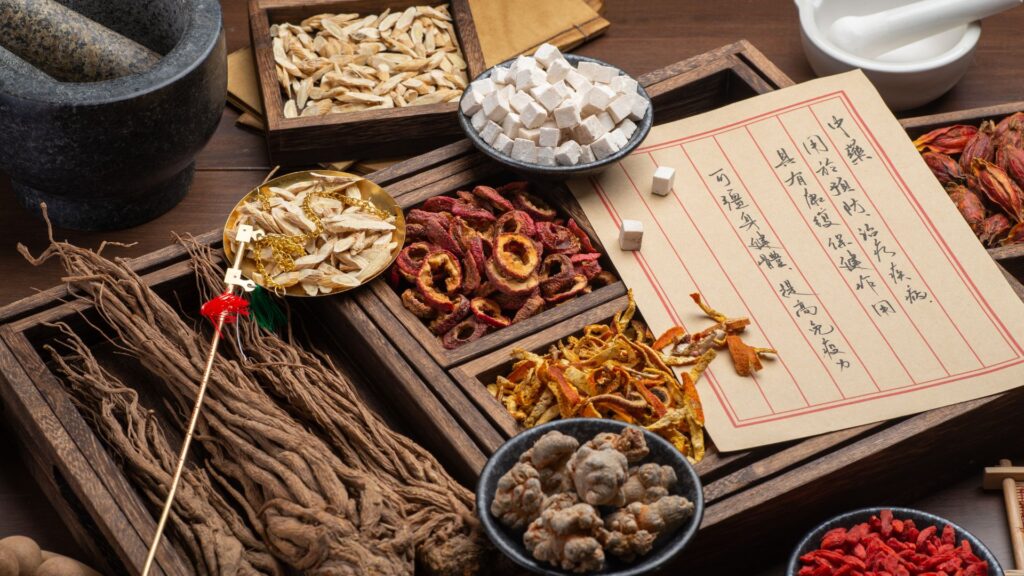
Herbal medicine offers another layer of support, particularly in cases where long-standing imbalance is present.
In Traditional Chinese Medicine, herbal formulas are not prescribed based on a single diagnosis, but on the specific pattern of imbalance observed in the patient.
For example, formulas that support digestive function and energy production, such as Liu Jun Zi Tang, may be used when fatigue and poor nutrient absorption contribute to overall weakness.
Herbs that regulate Liver function, such as Xiang Fu and Yu Jin, are often used in cases where stress and emotional tension affect circulation.
In situations where heat or inflammation is present, herbs like Huang Qin may be included to help clear internal heat and support vascular health.
These formulas are individualized and adjusted over time, which allows treatment to address the root of the condition rather than only the symptom.
Research consistently shows that lifestyle plays a central role in erectile function.
Smoking, sedentary behavior, and metabolic imbalance significantly increase the risk of erectile dysfunction, while regular physical activity, weight management, and improved cardiovascular health can lead to measurable improvement.
Pelvic floor training has also been shown to restore function in a significant number of patients by improving local circulation and muscular support .
These factors are not secondary — they are fundamental to long-term outcomes.
For patients in Victoria, BC, an integrative approach to erectile dysfunction offers an opportunity to move beyond temporary solutions.
At Victoria Healing Space, treatment focuses on understanding the underlying pattern in each individual. This may include acupuncture, herbal medicine, and guidance on lifestyle changes, all aimed at restoring balance within the body.
Because when circulation improves, when the nervous system settles, and when the body is supported as a whole, function often returns naturally.
Erectile dysfunction is not simply a condition of performance.
It reflects how well the body can regulate circulation, respond to stress, and maintain balance across multiple systems.
When these processes are supported, improvement often follows — not as a forced response, but as a natural outcome of restored function.