
Many people with Hashimoto’s disease do not feel sick all at once.
The process is usually quiet in the beginning.
They simply notice that something about their body no longer feels the same.
They wake up tired even after sleeping. Their hands and feet are cold when everyone else feels comfortable. Digestion becomes slower. Constipation appears. Their face looks puffier in photographs. Hair changes. Weight increases even though they are not eating very differently. Their thoughts feel heavier somehow — less clear, less sharp, slower to move.
And often, what makes this experience particularly difficult is that outwardly, they may still look “fine.”
So they continue working, caring for others, pushing through exhaustion, while internally feeling as though their body is moving through wet cement.
Many patients later say the hardest part was not the diagnosis itself, but how long they felt something was wrong before anyone took it seriously.
Hashimoto’s disease, also called Hashimoto’s thyroiditis, is the most common autoimmune thyroid condition worldwide. It occurs when the immune system gradually attacks thyroid tissue, leading to chronic inflammation and, over time, reduced thyroid hormone production. Women are affected far more often than men, especially during periods of hormonal transition, chronic stress, postpartum recovery, or midlife changes.
But clinically, Hashimoto’s rarely feels like “just a thyroid problem.”
It affects energy, digestion, mood, metabolism, sleep, and the nervous system as a whole.
This is one reason many patients begin exploring acupuncture and Chinese medicine. In Traditional Chinese Medicine, Hashimoto’s is not viewed as an isolated thyroid condition, but as a deeper imbalance involving metabolism, digestion, stress regulation, inflammation, and long-term depletion of the body’s resources.
The thyroid influences almost every major system in the body.
It affects metabolism, temperature regulation, digestion, cardiovascular function, hormonal balance, mood, cognition, skin, fertility, and energy production. When thyroid function slows, the effects are rarely isolated.
This is why patients may experience:
fatigue, depression or anxiety, difficulty concentrating, weight gain, constipation, swelling, irregular menstrual cycles, infertility, joint stiffness, hair thinning, and increased sensitivity to cold.
Some patients describe it as feeling “less alive” inside their body.
And because the process is gradual, many people begin blaming themselves before realizing there is a physiological reason behind what they are experiencing.
One of the most important things to understand about Hashimoto’s disease is that it is not only about low thyroid hormone.
It is an autoimmune condition.
This means the immune system itself has become dysregulated.
The body begins recognizing thyroid tissue as something foreign and gradually attacks it through immune-mediated inflammation. Blood tests often reveal elevated thyroid antibodies such as TPO antibodies or thyroglobulin antibodies, sometimes years before major hormonal changes appear.
Research increasingly shows that autoimmune disease does not develop from one single cause. Instead, it tends to emerge through the interaction of genetics, chronic stress, hormonal shifts, inflammation, gut health changes, immune dysregulation, and environmental triggers.
This complexity is one reason why many patients feel frustrated when treatment focuses only on replacing thyroid hormone while many symptoms remain unresolved.
Hormone replacement can be extremely important and necessary. But for many people, it does not fully explain why they still feel exhausted, inflamed, emotionally overwhelmed, or disconnected from their body.
One of the reasons acupuncture and Chinese medicine often resonate with Hashimoto’s patients is that they look beyond laboratory values alone.
The focus is not only the thyroid itself, but how the entire system is functioning.
Traditional Chinese Medicine obviously did not use the word “autoimmunity,” but classical Chinese medicine described patterns remarkably similar to what many Hashimoto’s patients experience today.
Rather than viewing the condition as isolated thyroid failure, Chinese medicine sees it as a deeper systemic imbalance involving metabolism, digestion, nervous system regulation, fluid accumulation, and depletion over time.
One of the central ideas in Chinese medicine is that the body must constantly transform:
food into energy,
fluids into nourishment,
stress into movement,
and rest into recovery.
When this transformation weakens, the body begins slowing down internally.
This is where many Hashimoto’s patients recognize themselves immediately.
In Chinese medicine, the Spleen system is responsible for producing energy from food and regulating fluid metabolism.
When this system weakens:
fatigue develops,
digestion slows,
fluid retention appears,
weight becomes harder to regulate,
and heaviness and brain fog increase.
Classical Chinese medicine texts describe this process in people who are chronically overworked, emotionally burdened, sleep-deprived, worried, or consuming foods that weaken digestion over time.
Interestingly, modern research now strongly supports the relationship between chronic stress, inflammation, gut dysfunction, and autoimmune thyroid disease. Researchers are increasingly studying the “gut-thyroid axis” and how microbiome imbalance and immune dysregulation may contribute to Hashimoto’s progression.
This overlap between ancient observation and modern physiology is one reason many patients feel deeply understood when hearing a Chinese medicine explanation for the first time.
Many patients can identify a period when their symptoms became dramatically worse:
after childbirth,
after burnout,
during prolonged emotional stress,
after grief,
or after years of pushing through exhaustion.
From a biomedical perspective, chronic stress affects cortisol regulation, inflammatory pathways, sleep, digestion, hormones, and immune signaling.
From a Chinese medicine perspective, prolonged stress causes what is called Liver Qi stagnation — a disruption in the body’s ability to regulate movement smoothly.
Over time, this affects digestion, circulation, hormonal balance, and emotional resilience.
The body begins compensating constantly.
Eventually, compensation becomes exhaustion.
One thing many Hashimoto’s patients notice after acupuncture is not stimulation, but regulation.
They sleep more deeply.
Their digestion becomes calmer.
Their hands and feet feel warmer.
Their nervous system softens.
Their body feels less “stuck.”
Research suggests acupuncture may influence autonomic nervous system regulation, inflammatory pathways, stress response, and immune activity.
And for patients whose bodies have been living in chronic compensation for years, this regulation matters deeply.
One of the biggest misconceptions about Chinese herbal medicine is that there is “one thyroid formula.”
There is not.
In Chinese medicine, two patients with Hashimoto’s may receive completely different treatments depending on their presentation.
Some people need support for digestion and energy production.
Some need warming because their metabolism feels profoundly cold and depleted.
Some need help resolving fluid accumulation and stagnation.
Others need nervous system regulation because stress has become central to the condition.
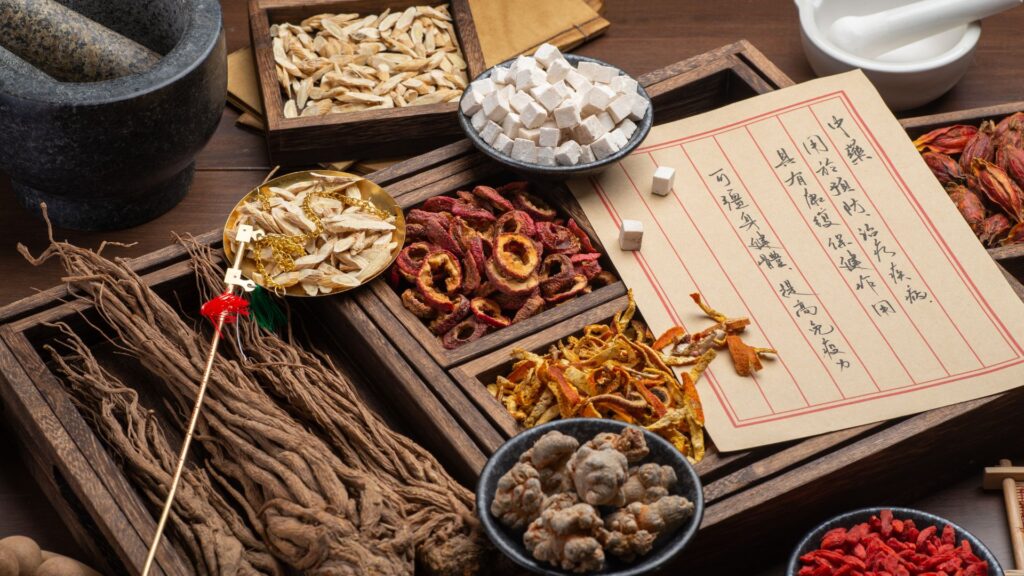
Classical formulas often used clinically include herbs such as Huang Qi (Astragalus), Bai Zhu, Fu Ling, Shan Yao, Dang Shen, Xia Ku Cao, Hai Zao, and Kun Bu.
Modern research is now examining how many of these herbs influence inflammation, immune regulation, oxidative stress, metabolism, and gut function.
But clinically, herbal medicine is not simply about “stimulating the thyroid.”
The goal is to support the environment in which the thyroid and immune system are functioning.
Hashimoto’s disease develops slowly.
The body does not become exhausted overnight, and healing rarely happens overnight either.
This is important because many patients are already living in a state of pressure:
trying harder,
pushing harder,
forcing themselves through fatigue.
But healing from chronic autoimmune dysregulation is usually not about forcing.
It is about helping the body regain the ability to regulate itself again.
Sometimes the first improvement is not dramatic.
It is simply waking up with slightly more energy, needing less recovery time, feeling mentally clearer, or no longer feeling cold all the time.
These changes matter.
Because they often mean the body is no longer fighting itself as intensely.
Hashimoto’s disease is often described medically as thyroid inflammation.
But for many people living with it, it feels much bigger than that.
It affects energy, mood, digestion, sleep, resilience, metabolism, and the ability to feel like oneself again.
This is why many patients seek acupuncture and Chinese medicine alongside conventional care — not because the thyroid matters less, but because the rest of the body matters too.
Chinese medicine approaches Hashimoto’s by asking a broader question:
Not only “What hormone is low?”
But:
“What has been happening in this body for years that made this possible?”
Sometimes that question changes everything.
Interested in Chinese herbal medicine as part of your recovery?
Learn more about how personalized herbal formulas are prescribed and dispensed at Victoria Healing Space.