
Cupping in Victoria BC
When to Choose Cupping
Cupping in Victoria BC can help if some areas of your body may feel like they never fully relax. Or, you might notice a shoulder that stays tense, a back that feels tight after sitting, or muscles that still feel restricted after stretching.
Cupping works with these tissues in a different way.
Instead of pressing down, cupping uses gentle, controlled suction to lift the skin and the connective tissue just beneath it. This is why people sometimes describe cupping as a “reverse massage.”
At Victoria Healing Space, cupping may be used on its own or combined with acupuncture. Your treatment is planned around your symptoms, health history and goals.
Looking for cupping therapy in Victoria, BC?
What Is Cupping?
Cupping is a traditional Chinese medicine technique. Special cups are placed on selected areas of the body, and suction is created inside the cups.
Your practitioner adjusts the suction, cup placement and treatment time to suit you. Cupping does not need to feel intense or leave dark marks to be helpful.
Cups may be made from different materials:
- Glass cups: Traditionally used for fire cupping. A brief flame creates suction inside the cup before it is placed on the body. The flame does not touch your skin.
- Plastic cups: Suction is created and adjusted with a hand-operated pump.
- Silicone cups: Flexible cups allow the practitioner to create and adjust suction manually.
Glass, plastic and silicone cups can all remain stationary or be moved over the skin. The choice of cup depends on the treatment area, the amount of suction needed and your individual sensitivity.
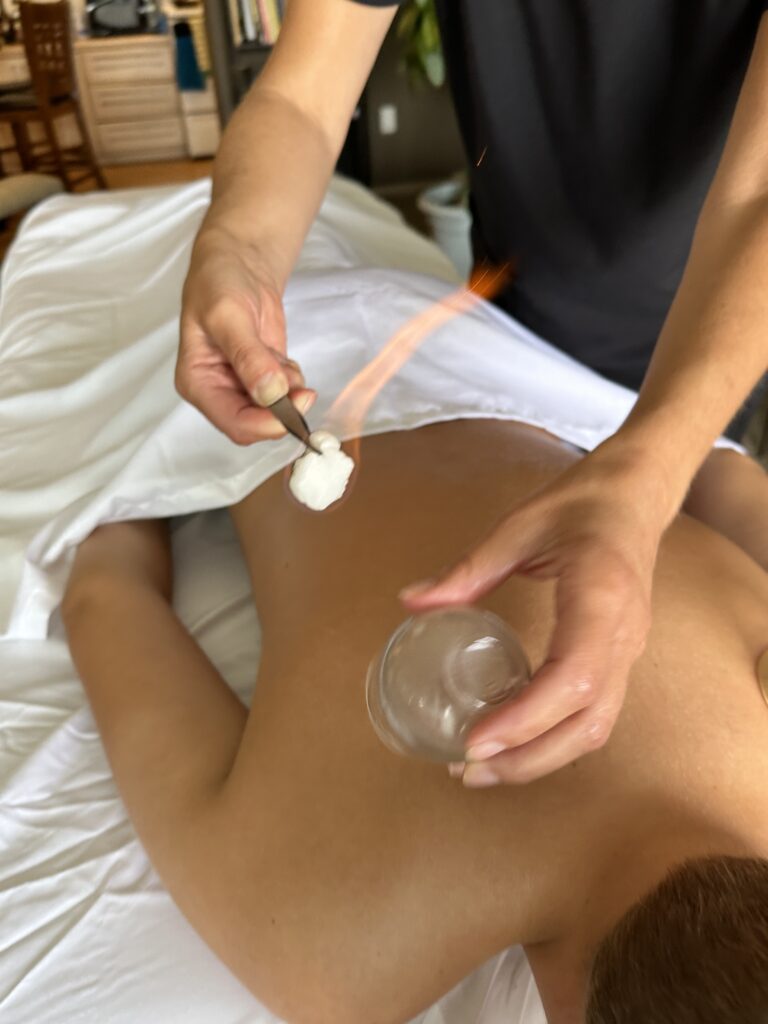
Cupping methods
Cupping may be applied in different ways:
- Stationary cupping: Cups stay in selected locations for several minutes.
- Sliding cupping: Oil is applied so the cups can glide over a larger area.
- Flash cupping: Cups are applied and removed repeatedly to provide shorter and gentler stimulation.
- Bleeding cupping: A carefully selected area is lightly pierced with a sterile, single-use lancet or three-edged needle before a cup is applied. This technique is used only when clinically appropriate and requires additional infection-control precautions.
Cupping is commonly used on the back, shoulders, neck, hips and legs. The technique depends on where you have symptoms, how sensitive your tissues are and what you want to address.
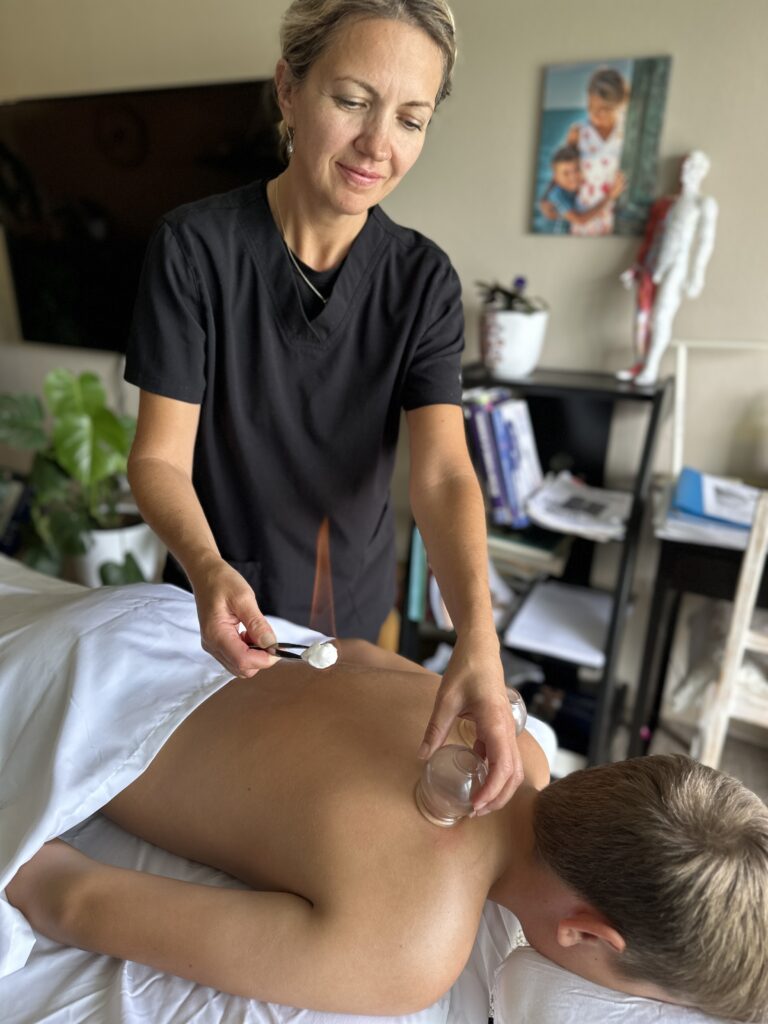
What Does Cupping Feel Like?
Most people feel a firm pulling or stretching sensation under the cup. It may feel unusual at first, but it should not feel sharp, burning or unbearably painful.
Cupping feels different from deep massage. Massage presses into the tissues, while cupping gently lifts them. Many people notice warmth, relaxation or easier movement afterward.
Your comfort matters. We can reduce the suction or remove a cup at any time.
When May Cupping Be Used?
Cupping may be considered for musculoskeletal pain, respiratory congestion and physical tension associated with stress.
Your practitioner may consider cupping for:
Pain, Muscle Tension and Movement
- Back pain and low-back tension
- Neck and shoulder pain
- Upper-back tension from desk work
- Muscle tightness and stiffness
- Restricted movement
- Hip and gluteal tension
- Sore muscles after exercise
- Sports-related muscle tension
- Muscular strains and repetitive-use tension
Coughs and Respiratory Congestion
- Chest and upper-back congestion
- Lingering cough after a cold or respiratory illness
- Muscle tension caused by repeated coughing
- Nasal congestion associated with a cold
- Upper-back tension accompanying respiratory congestion
Stress-Related Muscle Tension
- Neck and shoulder tension associated with stress
- Upper-back tightness
- Difficulty physically relaxing
- Shallow or restricted-feeling breathing associated with muscular tension
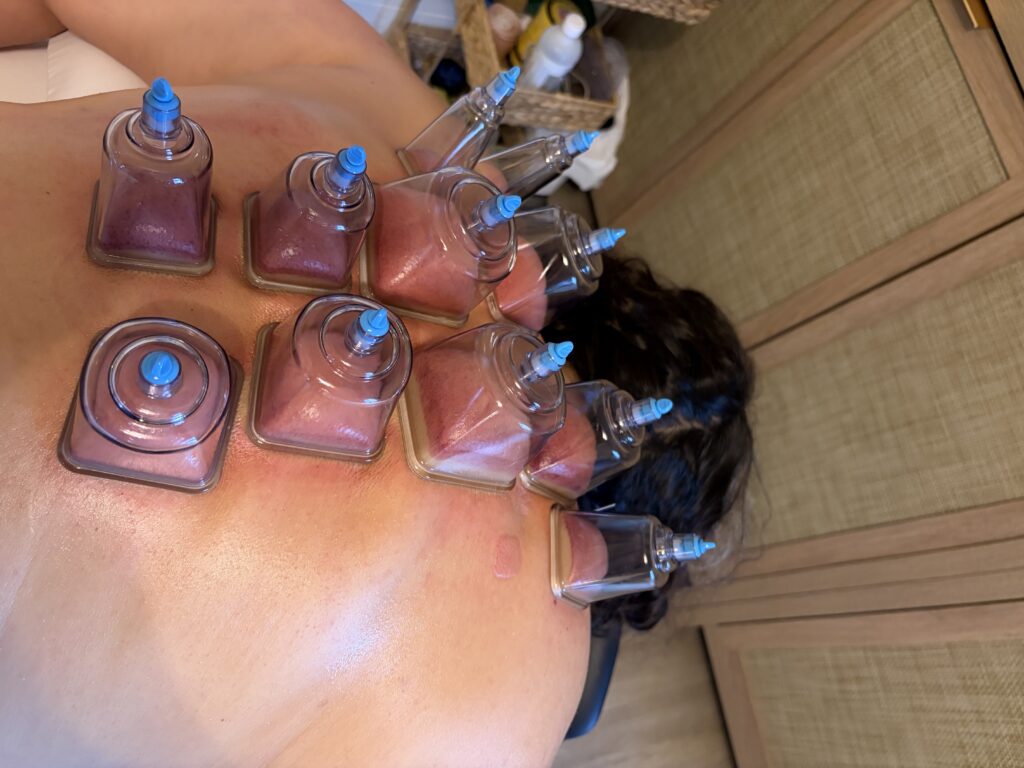
What Do Cupping Marks Mean?
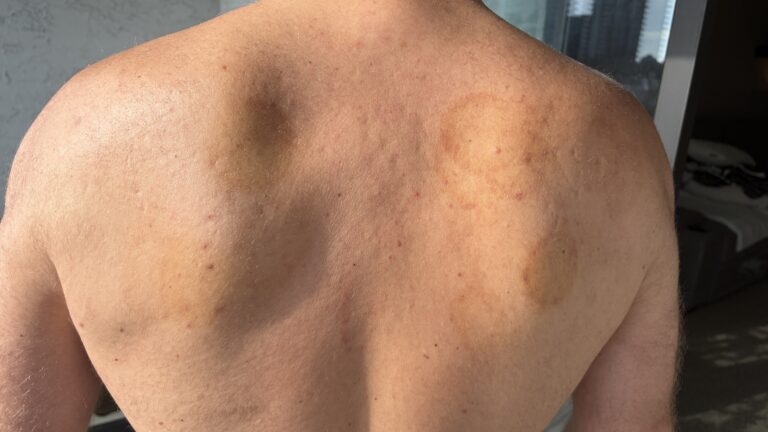
Stationary cupping may leave circular pink, red or purple marks. Their appearance can be understood from both a modern physiological perspective and a Traditional Chinese Medicine perspective.
From a Western Physiological Perspective
Suction lifts the skin and superficial connective tissue and changes pressure within the small blood vessels beneath the cup. This can increase local blood flow and allow a small amount of blood and fluid to move from superficial capillaries into the surrounding tissue, producing temporary discolouration.
The colour and intensity of a mark can depend on:
- The strength of the suction
- How long the cup remains in place
- The location and thickness of the tissue
- The depth and fragility of the local capillaries
- Age and connective-tissue condition
- Medications that affect bleeding or bruising
- The individual response of that particular area
A darker mark does not mean that the treatment was more successful. It may simply reflect a stronger suction dose or an area that marks more easily.
From a Traditional Chinese Medicine Perspective
In Traditional Chinese Medicine, cupping marks are traditionally observed as part of the overall clinical picture.
A practitioner may interpret darker red or purple marks as suggesting more pronounced local stagnation of Qi and Blood, often called Blood Stasis. Lighter pink or red marks may suggest a milder or more superficial response. Marks that appear slowly or remain very light may be considered differently depending on the patient’s constitution, temperature pattern and other findings.
However, colour is never interpreted by itself. The practitioner also considers:
- The location and quality of the symptoms
- Whether the area feels warm or cold
- The character of the pain
- The tongue and pulse
- The patient’s constitution
- The strength and duration of suction
- Medications and health history
Cupping Provided by Licensed Practitioners
At Victoria Healing Space, cupping is provided by licensed acupuncture and Traditional Chinese Medicine practitioners regulated by the College of Complementary Health Professionals of British Columbia.
In BC, suction cupping is included within the professional scope of acupuncture. Your practitioner assesses whether cupping is appropriate, explains the treatment, obtains your consent and follows professional safety and infection-control standards.
FAQ
Cupping and Acupuncture: Why Combine Them?
Cupping and acupuncture work in different ways and may complement each other.
Cupping covers a broader area and may be useful when muscles and superficial connective tissues feel tight or restricted. Acupuncture allows your practitioner to choose precise points based on your symptoms and overall health picture.
A combined treatment may begin with cupping to warm and decompress a tight area, followed by acupuncture. In other cases, acupuncture may come first, with gentle cupping added afterward.
There is no single treatment plan that works for everyone. We choose the techniques, sequence and intensity after assessing your needs.
How Cupping Affects Fascia and Connective Tissue?
Fascia is a network of connective tissue that surrounds and connects muscles, nerves, blood vessels and other structures. It helps different tissues glide as you move.
Cupping uses lifting pressure rather than compression. This may temporarily change tension, movement and circulation in the superficial tissues.
Some practitioners describe this as creating more space between tissue layers. Cupping may also support the movement of interstitial fluid, which is the fluid found between cells, and may affect how the tissues glide.
You may hear this described as “rehydrating the fascia.” This is a clinical model, not proof that cupping literally adds water to dehydrated tissue. Research has not yet clearly established all of the ways cupping works or its long-term effects.
What matters most is how you respond. Changes in comfort, movement, sensitivity and function are more meaningful than the colour of a mark.
Are Cupping Marks the Same as Bruises?
Cupping marks and accidental bruises have something in common: both can involve a small amount of blood moving out of tiny blood vessels into nearby tissue.
They are created in different ways, however.
A typical bruise usually follows an impact or compression injury. It may be tender, swollen or irregular in shape. A cupping mark is created by controlled suction and usually has the round shape of the cup.
It is more accurate to describe a cupping mark as a controlled suction-related vascular response rather than saying it has no connection to bruising.
Cupping marks are temporary and often fade within several days. Darker marks may last longer. Please tell your practitioner if you have an upcoming event, photoshoot or activity where visible marks would be inconvenient.
Is Cupping Safe for Everyone?
Cupping is generally well tolerated when it is appropriate for you and performed by a trained practitioner. However, it is not suitable for every person or every area of the body.
Cupping is avoided over wounds, infections, burns, fractures, varicose veins, fragile skin and areas with reduced sensation.
Cupping is not provided for patients with a pacemaker, serious heart or heart-valve disease, blood clots, severe anemia or bleeding disorders.
It may also be unsuitable for patients who are very weak, depleted, light-headed or recovering from serious illness. We assess your overall condition and check your pulse before deciding whether cupping is appropriate.
Please tell us if you take blood-thinning medication or bruise easily.
During pregnancy, cupping is avoided over the abdomen and low back. Strong and bleeding cupping are not used.
Possible effects include temporary marks, tenderness, skin irritation or light-headedness. We review your health history and obtain consent before treatment.
Cupping Aftercare: How to Care for the Treated Area
After treatment, the area may feel warm, relaxed or temporarily tender. Cupping marks usually fade within several days.
After cupping:
- Drink extra water to stay well hydrated.
- Avoid alcohol for the remainder of the day.
- Avoid greasy, fatty or difficult-to-digest foods.
- Keep the treated area clean, covered and protected from cold air or drafts.
- Do not scratch, scrub or vigorously rub the marks.
- Avoid very hot showers, baths, saunas and hot tubs while the skin is sensitive.
- Avoid strenuous exercise until tenderness settles.
- Do not apply irritating or strongly fragranced products.
Contact the clinic if you develop blistering, increasing pain, unusual swelling, spreading redness, discharge or signs of infection.